
How to use Seachem Prime
Seachem’s official Prime dose, when to add it to new water, how test kits can misread it, and how Safe and Fritz Complete compare.
Tap water is not ready for a tank until chlorine or chloramine is removed. Those disinfectants protect drinking water, but they harm fish and the bacteria that run your filter. Seachem Prime is a concentrated conditioner for fresh and saltwater that removes chlorine and chloramine and detoxifies ammonia, nitrite, and nitrate. This guide follows Seachem’s published directions, and notes Fritz Complete where its official dose is useful as a second option.
What you’ll need
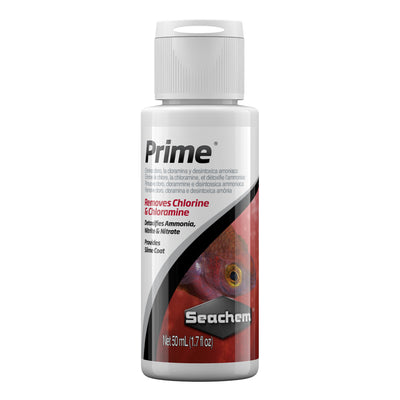

another concentrated conditioner, if you prefer Fritz’s dose
From $4.46
Choose size


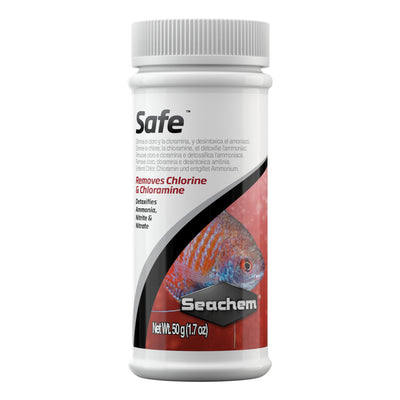
Seachem recommends this when you add new fish, used with Prime
From $3.45
Choose sizePrime is for new water, water changes, and emergency ammonia or nitrite. It is not a cycle by itself. See Cycling a new tank for that process.
Seachem’s published Prime dose
From Seachem’s Prime page: Seachem PrimeView product →
- Use 1 capful (5 mL) for each 200 L (50 US gallons) of new water.
- Each cap thread is about 1 mL, which helps with smaller volumes.
- It may be added to the aquarium directly, but Seachem says it is better if added to the new water first. If you add it straight to the tank, base the dose on the aquarium’s volume.
- A sulfur smell is normal.
- For exceptionally high chloramine, a double dose may be used safely.
- To detoxify nitrite in an emergency, up to 5 times the normal dose may be used. Seachem’s FAQ says this is appropriate when ammonia or nitrite is above 2 ppm.
- If the temperature is above 30 °C (86 °F) and chlorine or ammonia levels are low, use a half dose.
Seachem also says Prime can be dosed every 24–48 hours, that it will not over-activate protein skimmers, and that it will not change pH.
Seachem Prime dose chart by gallons
Seachem’s dose works out to 0.1 mL (about 2 drops) per US gallon of new water, 1 mL per 10 gallons, and 1 capful (5 mL) per 50 gallons. Each cap thread is about 1 mL. The double dose is the one Seachem lists for elevated ammonia (around 2 ppm), nitrite, chlorine, or chloramine. Seachem’s maximum is 5 times the standard dose.
| Water volume | Standard dose | Drops (approx.) | Double dose |
|---|---|---|---|
| 1 gal | 0.1 mL | 2 | 0.2 mL |
| 5 gal | 0.5 mL | 10 | 1 mL |
| 10 gal | 1 mL | 20 | 2 mL |
| 20 gal | 2 mL | 40 | 4 mL |
| 29 gal | 2.9 mL | 58 | 5.8 mL |
| 40 gal | 4 mL | 80 | 8 mL |
| 55 gal | 5.5 mL | 110 | 11 mL |
| 75 gal | 7.5 mL | 150 | 15 mL |
| 125 gal | 12.5 mL | 250 | 25 mL |
For a water change, dose the gallons of new water you are adding. If you add Prime straight into the tank, dose for the whole tank volume, including the sump. Source: Seachem’s Prime dosing instructions. Gallon rows are simple math from Seachem’s 5 mL per 50 gallons.
How to use it on a water change
- Measure the new water, not just the glass. Dose for the volume you are preparing. If you pour Prime into the tank instead, dose for the tank’s full volume, including the sump.
- Add Prime to the new water and mix. Then add that water to the tank. This is the method Seachem prefers. For the full drain-and-refill steps, see How to do an aquarium water change; a Flipper Bucket Buddy clip keeps the hose on the bucket while you drain.
- Match temperature as closely as you can so the change is gentle on fish and corals. For saltwater, mix and measure salinity first — see Which salt should I buy?. Salt mixes we carry include Tropic Marin Pro-Reef and Tropic Marin Classic.
- Do not use Prime as a reason to skip testing. After a cycle, or when something looks off, test ammonia and nitrite. Our testing guide covers which kits to keep on hand.
What Prime does — and what a test kit may show
Seachem is clear that Prime does not remove ammonia, nitrite, or nitrate from the system. It binds them so they are less harmful to animals, while still leaving them available for your beneficial bacteria. Seachem says that bond can last up to 48 hours. If the compounds are still there after that, they are released unless you dose again.
This is why some test kits look wrong after you add Prime. Seachem says a Nessler-style ammonia kit will not read properly and can look “off scale.” A salicylate kit can be used if you read it right away. Their preferred option is the MultiTest: Ammonia kit, which uses a gas-exchange sensor that is not affected by Prime.
If you would rather use a powder: Seachem Safe
Seachem Safe is the dry counterpart. Seachem’s directions: Seachem SafeView product →
- On the 50 g size: 200 mg (the included scoop) per 50 US gallons (200 L) for chlorine and chloramine, or per 13 US gallons (50 L) for ammonia.
- On the other sizes: 1.25 g (1/4 teaspoon) per 300 US gallons (1,250 L) for chlorine and chloramine, or per 75 US gallons (300 L) for ammonia.
- Best added to new water first. If you add it straight to the aquarium, dose for the aquarium’s volume.
Fritz Complete, if that is the bottle you have
Fritz’s published dose for Fritz Complete is 1 teaspoon (5 mL) per 50 US gallons (189 L). Fritz says to treat tap water in a separate container before adding it to the aquarium, or to add it directly to the tank when you are treating ammonia. For very high ammonia, Fritz says the dose may be increased or repeated up to 5 times within 24 hours. Fritz also notes a sulfur odor is normal, that Complete will not over-activate skimmers or affect pH, and that Nessler-type ammonia kits will not be accurate while it is in the water.
Use one conditioner at a time and follow that bottle’s label. The standard doses happen to match at 5 mL per 50 gallons, but the emergency and temperature notes differ, so stay with the maker you are using.
For a first freshwater setup, see Setting up your first freshwater tank. If the tank is still cycling, start with Cycling a new tank.
Orders ship in 1–2 business days, and shipping is free on orders of $35 or more. Most equipment is returnable for 365 days with free return shipping and no restocking fee. Opened chemicals, foods and medications are not returnable.
If you want help matching a bottle size to your water-change volume, ask us through the contact form.