
Cycling a new tank
What the nitrogen cycle is, how to cycle with bottled bacteria, and how to know when it’s safe to add fish.
Fish waste and leftover food break down into ammonia, which is toxic. Nitrifying bacteria turn ammonia into nitrite (also toxic) and then into nitrate, which is far less harmful and removed with water changes. “Cycling” means growing enough of those bacteria before you add livestock.
What you’ll need



Fishless cycle, step by step
- Dechlorinate first. Chlorine and chloramine kill the bacteria you’re adding. Brightwell, Fritz and Seachem all say to remove them before dosing.
- Switch off UV and ozone. Brightwell also says to turn off the protein skimmer and remove filter socks while cycling with MicroBacter Start. Fritz says to keep UV off before and for 4 days after each FritzZyme dose.
-
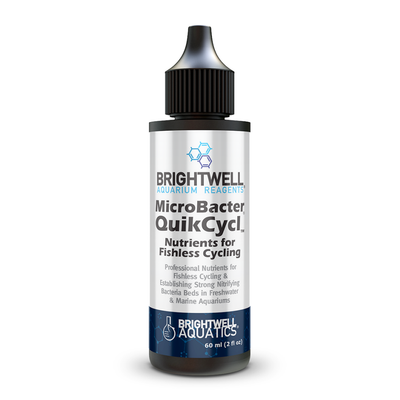
Add an ammonia source. With QuikCycl, Brightwell says to add a full dose (4 drops per gallon, or 1 mL per 5 gallons) and aim for 1–2 ppm total ammonia. Don’t keep adding more to raise the reading.
 MicroBacter QuikCyclView product →
-
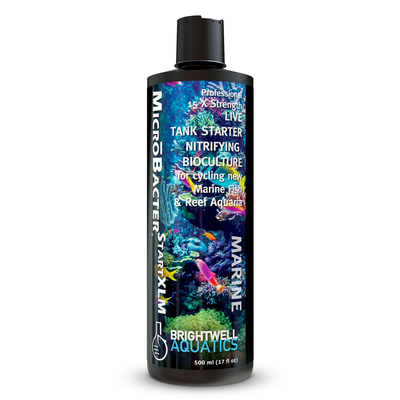
Add the bacteria. Shake well and dose for your total water volume, including the sump. Each bottle has its own dose; the “How to use” section on each product page has the manufacturer’s numbers.
 MicroBacter Start XLMView product →
-
Test daily. Watch ammonia, then nitrite, rise and fall. Nitrate appearing means the bacteria are working.
 Seachem MultiTest: AmmoniaView product →
- Know when it’s done. Brightwell considers the tank cycled when ammonia and nitrite both read zero and nitrate is 0.25 ppm or higher. After a QuikCycl cycle, Brightwell recommends a 25% water change.
- Add livestock slowly. Start with a few hardy animals and keep testing. A new biofilter grows with the load you give it.
Tips that save time
- Use one bacteria brand at a time. Brightwell recommends not using any other bacteria product until a MicroBacter cycle is complete.
- Brightwell advises waiting to add “live sand” or dry-seeded rock until cycling with MicroBacter Start is complete.
- Brightwell recommends holding off on carbon and GFO until the cycle is finished plus 30 days.
- Don’t clean the filter during cycling. That’s where most of the bacteria live.
- Stalled? Check temperature and pH and re-test. Fritz publishes ideal ranges for FritzZyme on its product page.
Cycling with fish?
Some bacteria makers support adding livestock right away. Fritz, for example, says to add livestock within 24 hours of dosing FritzZyme and not to overstock or overfeed. If you go this route, start with very few hardy animals, test ammonia and nitrite daily, and be ready to do a water change if either climbs. A water conditioner like Seachem Prime is useful to have on hand.